Connecting regions, scales and disciplines.
A laboratory that connects regions, scales, disciplines, and institutions to understand ecological change.
Who we are
Ecological understanding.
Conservation in practice.
The Longo Marine Ecology Lab is led by Dr. Guilherme O. Longo, a marine ecologist whose work examines how human-driven environmental change reshapes marine ecosystems across biological scales. The lab integrates fundamental ecology with conservation science to understand mechanisms, anticipate change, and support decisions.
Founded in 2016 at the Universidade Federal do Rio Grande do Norte in Northeast Brazil, the lab expanded to the University of Massachusetts Boston in 2026. This growth connects tropical and temperate systems while preserving the lab’s long-term commitment to Brazilian ecosystems, collaborators, students, and communities.
Today, our work bridges organisms and ecosystems, experiments and global synthesis, discovery and implementation. We collaborate with universities, government agencies, research networks, funders, conservation organizations, local stakeholders, and communicators to produce science that is rigorous, useful, and publicly accessible.
Our approach
Mechanisms, patterns and predictions.
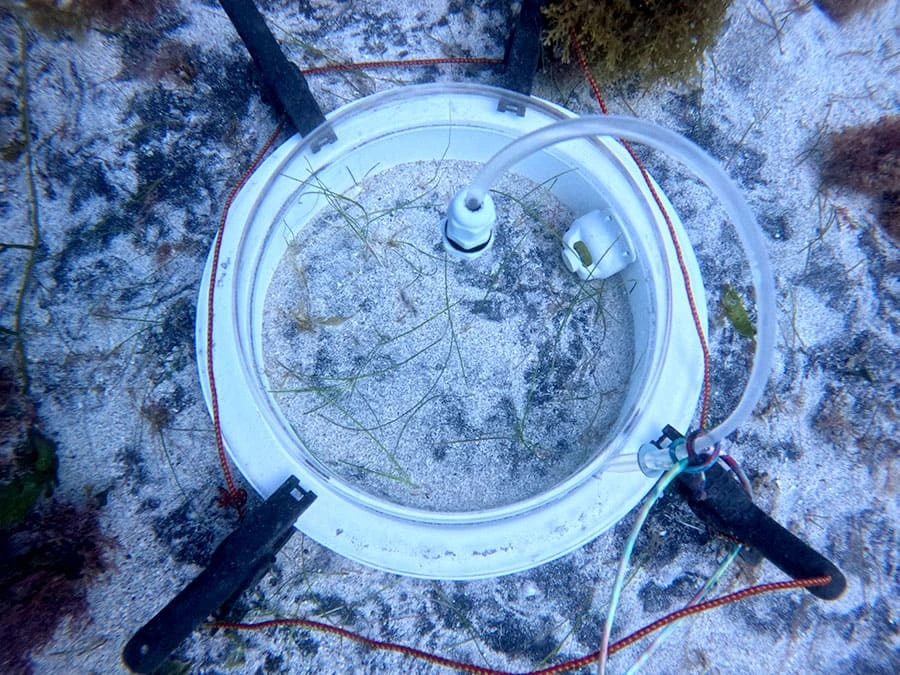
- Field ecology across natural gradients, environmental extremes, and biogeographic transitions.
- Controlled experiments that reveal physiological and ecological mechanisms.
- Trait-based approaches and species-interaction networks that connect processes across scales.
- Long-term monitoring, standardized datasets, and distributed collaborations.
- Ecological modeling and forecasting designed to inform conservation and management.
Our commitments
Rigorous science.
Shared responsibility.
- Scientific rigor, transparency, collaboration, and open exchange.
- Inclusive training and meaningful opportunities for people historically underrepresented in science.
- Long-term partnerships that respect place, local knowledge, and institutional continuity.
- Communication that makes evidence understandable without oversimplifying uncertainty.
- Research that connects ecological theory with conservation, climate adaptation, and public value.
What drives us
How can we understand and anticipate ecological change in ways that sustain biodiversity and the human societies that depend on healthy marine ecosystems?
Join and collaborate
Connect your questions with ours.
Research collaborations, student opportunities, conservation partnerships and public engagement.