Understanding change.
Anticipating what comes next.

We build a predictive understanding of marine ecosystems under environmental change and translate it into actionable knowledge.

From thermal stress to human well-being.

Thermal tolerance and coral bleaching

Why do some corals persist under extreme thermal variability while others bleach or die? We combine field observations, standardized thermal-stress assays, physiological measurements, and symbiont characterization to identify mechanisms of resistance and recovery.

Approaches and connectionsField observations · thermal-stress assays · physiology · symbionts

Species interactions and reef resilience

Competition, herbivory, facilitation, mutualism, and disease transmission can amplify or buffer environmental stress. We test how these interactions change with temperature, nutrients, pollution, and community composition, and how their effects scale to ecosystem resilience.

Approaches and connectionsField and mesocosm experiments · interaction networks · community ecology

Range shifts and tropicalization

Warming oceans redistribute species and reorganize ecological relationships. We investigate how shifting distributions alter herbivory, competition, habitat structure, and ecosystem functioning across tropical–temperate transitions.

Approaches and connectionsEnvironmental gradients · long-term datasets · distribution modeling

Conservation, restoration, and nature-based solutions

We contribute to extinction-risk and ecosystem assessments, protected-area design, restoration principles, and scalable ecological interventions. Current work includes testing whether restoring detritivores can reduce disease risk and improve coral culture and recovery.

Approaches and connectionsRisk assessment · protected areas · coral culture · restoration experiments

Ecosystems and human well-being

Marine biodiversity supports food security, nutrition, fisheries, tourism, and cultural value. We connect ecological change to these benefits so that conservation priorities reflect both ecosystem function and human dependence.

Approaches and connectionsFisheries and nutrition · ecosystem services · local knowledge · decision support

Can natural processes help suppress coral disease?

The lab co-leads an international project supported by the G20 Coral Research & Development Accelerator Platform. With Mark Hay and Cody Clements at Georgia Tech, the project tests whether co-culturing corals with naturally occurring detritivores such as sea cucumbers can reduce organic matter and microbial pathogens, suppress disease, and accelerate coral culture and restoration across the Caribbean and tropical Atlantic.

Ecological mechanism
Detritivores remove organic material that can fuel microbial pathogens.
Geographic scope
Caribbean and tropical Atlantic
Team
Guilherme O. Longo · Mark Hay · Cody Clements
Funder
G20 Coral Research & Development Accelerator Platform
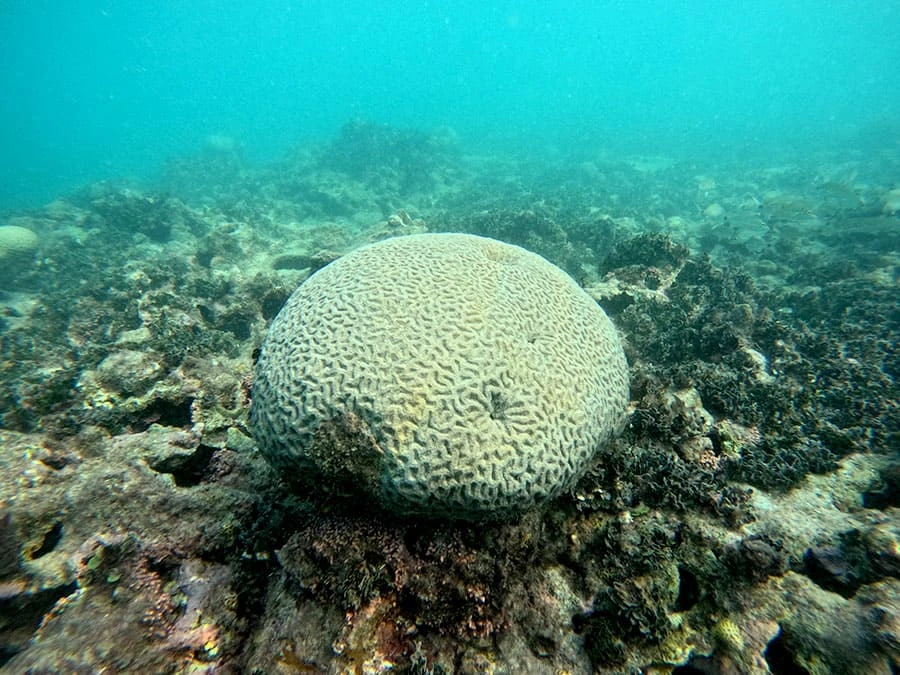
Coral colony observed during a research expedition in Abrolhos
Coral field image from Abrolhos. Source: IntegraMAR archive.

Marine biodiversity.
Connected research and conservation.

IntegraMAR is a Brazilian research network integrating marine biodiversity, human impacts, ecosystem services, management, and conservation. Supported by PPBio/CNPq, it connects researchers and institutions to inform the protection and sustainable use of coastal and reef ecosystems.

IntegraMAR

Local, global and combined impacts

Coordinated by Guilherme O. Longo. Axis 2 investigates how tourism, fishing, chemical and plastic pollution interact with ocean warming and acidification to affect marine biodiversity. Field surveys, experiments, remote sensing, and predictive models help identify vulnerable areas and potential climate refugia.

Explore Axis 2 (opens in a new tab)

New systems.
Connected questions.

A comparative research strategy connects natural gradients, experiments, long-term monitoring and ecological prediction.

Explore the evidence
  • Climate refugia and ecological hope spots in marginal reefs.
  • Trait-mediated interaction networks as predictors of reef robustness.
  • Temperate coral ecology and tropicalization in New England.
  • Interactions between global and local stressors.
  • Artificial intelligence and image annotation for reef monitoring.
  • Nature-based solutions, ecosystem services, and the marine bioeconomy.

Bring a complementary perspective.

We welcome comparative studies, coordinated experiments, shared datasets and projects connecting ecology with conservation decisions.

Work with us